What a plumbing estimate should include
A plumbing estimate is the written price you give a customer before the work starts. A good one answers three questions: what exactly you will do, what it costs, and what happens next. This plumber estimate template covers each part, so nothing is left to memory:
- Your company name, phone number and license number.
- The customer's details and the address of the job.
- A description of the work, plus what is included and what is not.
- Materials with quantities and unit costs, and your markup.
- Labor hours and your hourly rate.
- Other charges: permit, waste removal and travel.
- Tax, the total, how long the price is valid, the deposit, the warranty and a customer signature.
How to fill in each section
Scope of work. Write it like the customer will hold you to it. "Replace 40-gallon water heater with a new 50-gallon gas unit, new flex lines, valves and pan" is clear. "Water heater job" is not. Use the "Not included" box for anything you expect to be asked about later, such as drywall repair or moving a gas line.
Materials. List each item with a quantity and your actual unit cost. The template multiplies them and adds the markup in one step.
Labor. Enter hours and your hourly rate. If you price by the job, use one line with 1 hour and the job price as the rate.
Other charges. Permits, disposal of the old fixture and a trip charge are real costs, so they get their own boxes.
Terms. Set how many days the price is valid, ask for a deposit, state the warranty and get a signature and date.
How to apply a markup to materials
Markup covers the time you spend buying, hauling and warrantying parts, plus your overhead. The formula is simple:
Materials total = materials cost × (1 + markup %)
Enter your markup percentage in the materials section and the template does it for you. One caution: markup is not margin. A 30% markup on a $100 part sells it for $130, which is a margin of about 23%. If you need a specific margin, work backwards from it.
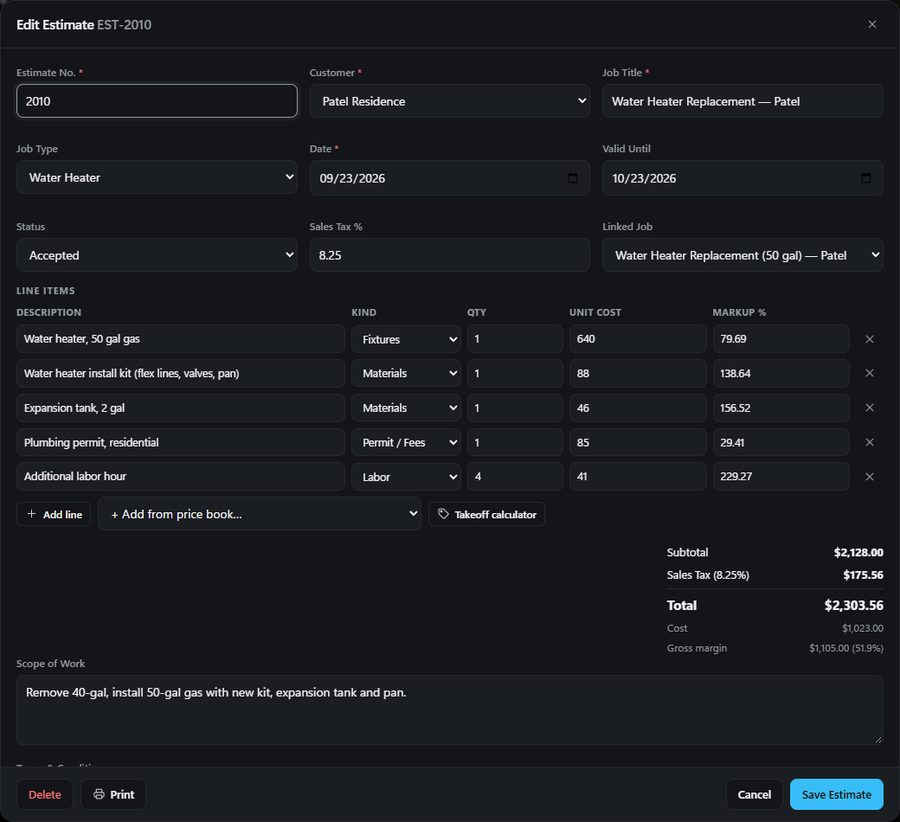
Example: water heater replacement (example numbers)
These are example numbers only. Your costs, rates and taxes will differ. Use the "Load the example numbers" link above to see the same job in the template.
| Item | Amount |
|---|---|
| Materials at cost: 50-gal gas water heater $640, install kit $88, expansion tank $46 | $774.00 |
| Materials markup, 30% | $232.20 |
| Labor: 4 hours at $95 | $380.00 |
| Permit $85 and disposal of the old tank $40 | $125.00 |
| Subtotal | $1,511.20 |
| Tax, 8% on the subtotal | $120.90 |
| Total | $1,632.10 |
With a 30% deposit, the customer pays $489.63 to schedule the job and the balance of $1,142.47 when it is finished.
Mistakes that cost plumbers money
- Forgetting the permit or disposal. If the fee is not on the estimate, you pay it out of your own pocket.
- Leaving the scope vague. Everything not written down becomes a free extra.
- Skipping the deposit and the signature. Without them, a customer can cancel after you have bought the parts, and there is no proof they agreed to the price.
- Guessing hours. Compare your estimated hours with the real ones after each job.
- Letting prices sit. Supplier costs change, so set an expiry and stick to it.
Word, Excel or online: which one to use
Many plumbing estimates templates online are locked or ask for your email first. This one is not. Use the online version when you want a clean estimate fast: type, print and send. Use the Word file if you want to change the wording or layout. Use the Excel plumbing estimating spreadsheet template if you like formulas: the markup, subtotals, tax and total are already built in, and only the input cells are open for typing.
If you are writing several estimates a week, copying and re-typing the same materials gets old. plumbing estimating software keeps a price book so you can build itemized estimates from saved items.