
HVAC software for heating and air contractors who would rather own it than rent it.
This is HVAC business software in one file. Build estimates from your own price book, put jobs on a dispatch board, cost every job and send invoices that track themselves.
It is HVAC management software you buy once. No monthly fee, no login, and it works with the Wi-Fi off.
Key benefits
One-time payment
No monthly fee and no yearly renewal. The price you see is the whole price.
Your price book, on every estimate
Cost, sell price, margin and install hours for every item, added in one pick.
A dispatch board
Technicians by day, one card per job, no-cool and no-heat calls in color.
Real margin per job
Job price minus equipment, parts and technician hours, from records you already entered.
HVAC management software for a small company
Everything a small heating and air company runs on, in one place.
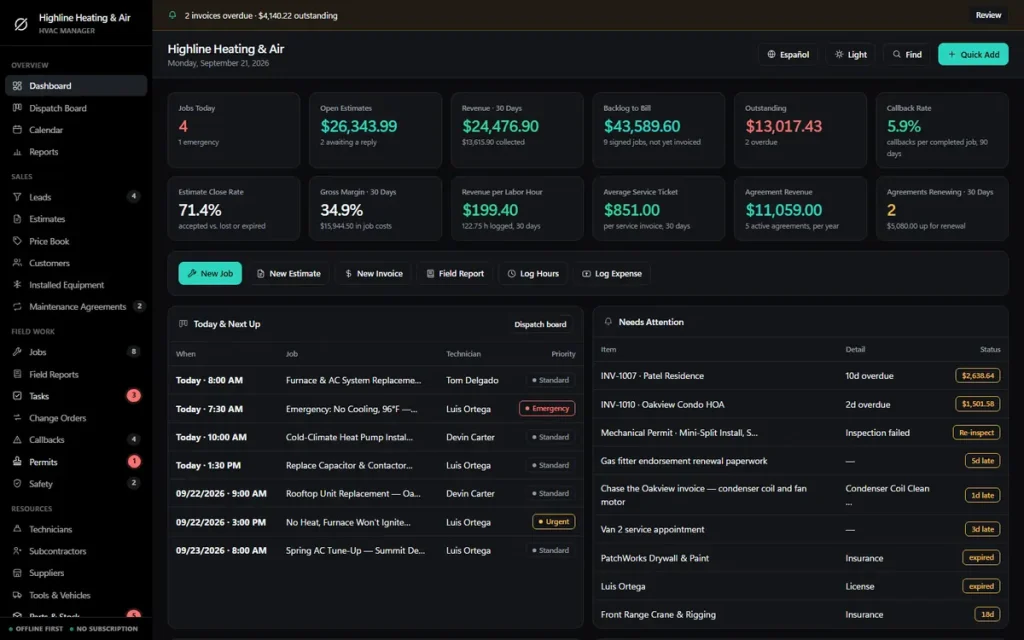
You get a dashboard, a dispatch board, a calendar, reports, leads, estimates, a price book, customers, installed equipment, maintenance agreements, jobs and field reports.
It also tracks tasks, change orders, callbacks, permits, safety, technicians, subcontractors, suppliers, tools and vehicles, parts and stock, invoices, purchase orders, expenses and timesheets. English and Spanish are both in the same file.
HVAC estimating software that uses your numbers
Enter your service calls, equipment, refrigerant, duct and parts once, each with a cost and a sell price.
Choose “Add from price book” on an estimate and the line lands with your cost and the markup that reaches your sell price. Tax, cost and gross margin update as you build.
The estimate prints on your letterhead with a signature line. Its status runs from draft to sent, accepted, rejected or expired, and the close rate shows on the dashboard.
A takeoff that also counts the labor
Type 35 ft of line set, 4 lb of refrigerant and 40 ft of trunk duct, then a waste percentage. The takeoff shows what to order, rounded up to whole units.
Give each item an install time and it adds one labor line at your own cost and billing rate. It is a quantity takeoff from your price book. It does not read plans.
HVAC scheduling software and a dispatch board
One row per technician and one column per day. Every job is a card with its arrival window, marked standard, urgent or emergency. A no-cooling call in July shows up in color.
Click the + in an empty cell to book a job into that slot, and see what is still unassigned. As HVAC dispatch software it is a board you fill in yourself.
Invoicing, including time and material
Service, deposit, progress, final, change-order and credit-memo invoices, with Paid, Partial and Overdue worked out for you. Bill labor hours at your rate plus parts with markup, or a flat price.
Job price plus approved change orders, minus expenses and technician hours, gives the margin. A 0 to 100 health score flags the jobs going wrong.
A simple HVAC CRM, with the equipment on file
Leads move from the first call to won or lost, and one button turns a lead into a customer. Each customer keeps their jobs, invoices and agreements.
They also keep the units at their site: model, serial number, refrigerant, where it sits, install date and warranty end. Search by serial number when a customer reads it to you over the phone. It is HVAC CRM software without the email campaigns.
Maintenance agreements that keep their own calendar
Spring AC tune-ups, fall furnace checks, filter programs and rooftop unit service. Each agreement has a price, visits per year, a next visit and a renewal date.
The dashboard adds up agreement revenue and lists what renews in the next 30 days. A warranty about to end shows up on your attention list, which is a good moment to offer one.
HVAC job management software
From estimate to paid in four steps.
Good HVAC service software has to keep four things in the same place: what you quoted, who is going, what it cost and what you are owed.
Quote it
Add the customer, then build the estimate from your price book. Use the takeoff for line set, refrigerant and duct, and print it for the customer to sign.
Schedule it
Accept the estimate and it becomes a job with its price and cost budget. Put it on the dispatch board with a technician, a day and an arrival window. Log the permit and the inspection date.
Do it and cost it
File the field report, log hours and expenses against the job and record change orders. Margin and health score update themselves, so a job spending faster than it is being built shows early.
Invoice and follow up
Raise the deposit, progress or final invoice, record the payment and see what is still owed. Backlog to bill, callbacks and agreement renewals show up before they are forgotten.
Longer jobs are managed at the level of a job: progress, tasks on a board, change orders and progress billing. It does not do Gantt charts, submittals or RFIs.
The HVAC numbers, on the first screen
Twelve figures an HVAC contractor actually steers by.
Jobs today, open estimates, revenue for the last 30 days, backlog still to bill, outstanding invoices, callback rate, estimate close rate, gross margin, revenue per labor hour, average service ticket, agreement revenue and agreements renewing.
Backlog to bill
The price of signed work, change orders included, that you have not invoiced yet. It tells you how much work is already sold before you look at the phone.
Average service ticket
The mean of your service invoices over the last 30 days. If it drifts down, you are doing more small calls for the same drive time.
Revenue per labor hour
Thirty days of billing divided by every hour logged in the timesheets. If it slips toward your labor cost, the dashboard warns you.
Agreement revenue
What your active maintenance agreements bring in per year, and how much of it comes up for renewal in the next 30 days.
Load calculations, accounting and field service, honestly
The business side of an HVAC company, without the monthly fee.
An HVAC company lives out of vans, attics and phone calls. HVAC software should keep the jobs, the money and the paperwork straight. It should also tell you where its limits are.
Is it HVAC load calculation software?
No. It does not run a Manual J load calculation, size equipment or design ductwork. Keep your load calc tool for that.
What it does is everything around the job: the estimate, the schedule, the invoice and the follow-up.
Accounting software for an HVAC business?
It covers the job side: invoices, payments, expenses, timesheets, job costing and margin, with every list exportable to CSV for your accountant.
It is not a general ledger. There is no payroll, no bank feed and no tax filing, so keep your bookkeeping program for those.
Field reports that print
The technician’s work performed, parts used and findings on one page, printable with a customer signature line, and linked to the job for costing.
Works with no signal
The file runs offline in your browser, on a laptop or tablet, in a mechanical room or on a roof. Nothing needs a connection once it is downloaded.
What it does not do
No GPS tracking, no route optimization, no customer self-booking, no automatic texts or emails, no card processing, no plan reading, no load calculations or code checks, and no two people editing at once.
It is the office record of the operation, not a live field service platform.
Refrigerant and safety records
Safety keeps toolbox talks, refrigerant handling, combustion and CO checks, lockout / tagout and leak or pressure tests. It is a place to write things down, not a compliance log, so keep the official records your certification asks for.
Choosing HVAC business software
You are not really choosing between two software packages.
Most HVAC software is rented by the month, and the records live on somebody else’s server. Spreadsheets are free but cannot build an estimate from a price book or keep a dispatch board.
This is HVAC software you own, with the heating and air parts built in.
| OwnDesk HVAC | Subscription HVAC software | Paper & spreadsheets | |
|---|---|---|---|
| Price | $ 49.00 once | Monthly fee, for as long as you use it | Free, but it costs your evenings |
| Estimates from a price book | Built in | Usually | By hand, every quote |
| Quantity takeoff with waste and install labor | Included (not plan-based) | Varies | Your own formulas |
| Technician dispatch board | Included | Usually | No |
| Maintenance agreements and installed equipment | Included | Varies | A list you keep up |
| Works offline | Yes | Often needs a connection | Yes |
| Your records if you stop paying | Still yours | Access ends | Still yours |
| GPS tracking, route planning, customer texts | Not included | Often included | No |
| Several people at once | Not included — one computer at a time | Usually included | Only through a cloud drive |
The subscription column is a general description of HVAC and field service software sold by the month, not a claim about any single company — features and pricing differ, so check each site. OwnDesk HVAC is single-computer software: it does not sync between devices, track vehicles, send messages, read plans, do load calculations or process card payments.
From payment to your first estimate
Three steps, about two minutes.
Pay with card
Checkout runs on Stripe. Your card details never touch this site.
Download and open
The link appears the moment payment clears. Double-click the file — it opens in your browser, no install, no internet needed after that.
Look around, then start fresh
It opens with a sample HVAC company already loaded. Clear it from Settings, which keeps your company name, logo and tax rate, then add your own price book, labor rates, customers and jobs.
If OwnDesk HVAC isn't right for how you run your heating and air business, email me and you get a refund — no questions. If something's confusing, you're writing to the person who built it, not a queue. English and Spanish, both spoken here.
Questions
Before you buy.
What is HVAC software?
What is the best HVAC business software for a small company?
Is this HVAC management software?
Does it work as HVAC service software?
How does the HVAC estimating software use my price book?
Does it do a takeoff for HVAC estimates?
Is this HVAC load calculation software?
Is it HVAC scheduling software?
Can it be used as HVAC dispatch software?
Can it work as a simple HVAC CRM?
How do maintenance agreements work?
Can I track the equipment installed at each customer?
Does it work as invoicing software for an HVAC business?
Is it accounting software for an HVAC company?
Can I track permits, inspections and callbacks?
Can several technicians or office staff use it at the same time?
Where are my records stored, and is there a subscription?
Build an estimate in it before you decide.
The live demo of this HVAC business software has real screens and a sample HVAC company loaded — no sign-up, no credit card. If it fits, buying takes about a minute.
14-day money-back guarantee · instant download · one-time payment